Posts mit dem Label University Strategy werden angezeigt. Alle Posts anzeigen

Donnerstag, 29. Juni 2023

Welche Aufgaben hat ein Hochschul-CIO bezüglich der Einführung und Nutzung generativer KI?

Im Juni 2023 hatten wir auf dem Hochschul-CIO-Kongress in Göttingen eine intensive Diskussion, welche Aufgaben ein CIO einer Hochschule bezüglich der Einführung und Nutzung generativer KI (z.B. ChatGPT) haben sollte. Die Diskussion entspann sich zwischen zwei extremen Positionen, die ich plakativ so dargestellt habe:

✅Die aktive Position ist: Ja, der CIO muss sich unbedingt einbringen und in den Fahrersitz. Es ist eine digitale Technologie, welche die Hochschulen grundsätzlich verändert.

❌Die Gegenposition dazu lautet: Nein, es ist nur eine cloudbasierte Technologie für digitales Lehren und Lernen. Es ist Thema der Hochschuldidaktik bzw. Prorektor:innen für Lehre. Die meisten Whitepaper, journalistischen Artikel und Webseiten von Hochschulen konzentrieren sich auf diese Position. Der/die CIO wird hier nicht gebraucht, denn die Technologieressourcen der Universität werden nicht beansprucht. Oder?

Die Kollegen von EDUCAUSE in den USA haben sich diese Frage auch gestellt und eine interessante Umfrage (Quickpoll) veröffentlicht. Eine große Mehrheit von 83% aller 440 antwortenden Educause-Mitglieder stimmten der Aussage zu, dass Generative KI die Hochschulen in den nächsten drei bis fünf Jahren positiv oder negativ verändern wird. Allerdings unterschieden sich die Antworten je nach Position der Befragten: während 90% der Leitungsebene für "instructional technology" oder von "teaching und learning centers" die Verantwortung dafür bei sich sahen, sagten im Gegenteil 58% der Leitung von IT-Einheiten, dass sie sich für KI nicht verantwortlich fühlten. Was die oben gezeigte Gegenposition unterstützen würde: ChatGPT ist nur (?) eine Frage der Hochschullehre.

Allerdings wurden in der Educause-Umfrage bei der Frage nach konkreten Beispielen auch Anwendungsfelder außerhalb von Lehren und Lernen genannt, unterteilt in die vier Felder: Dreaming, Drudgery, Design, and Development (siehe Grafik).
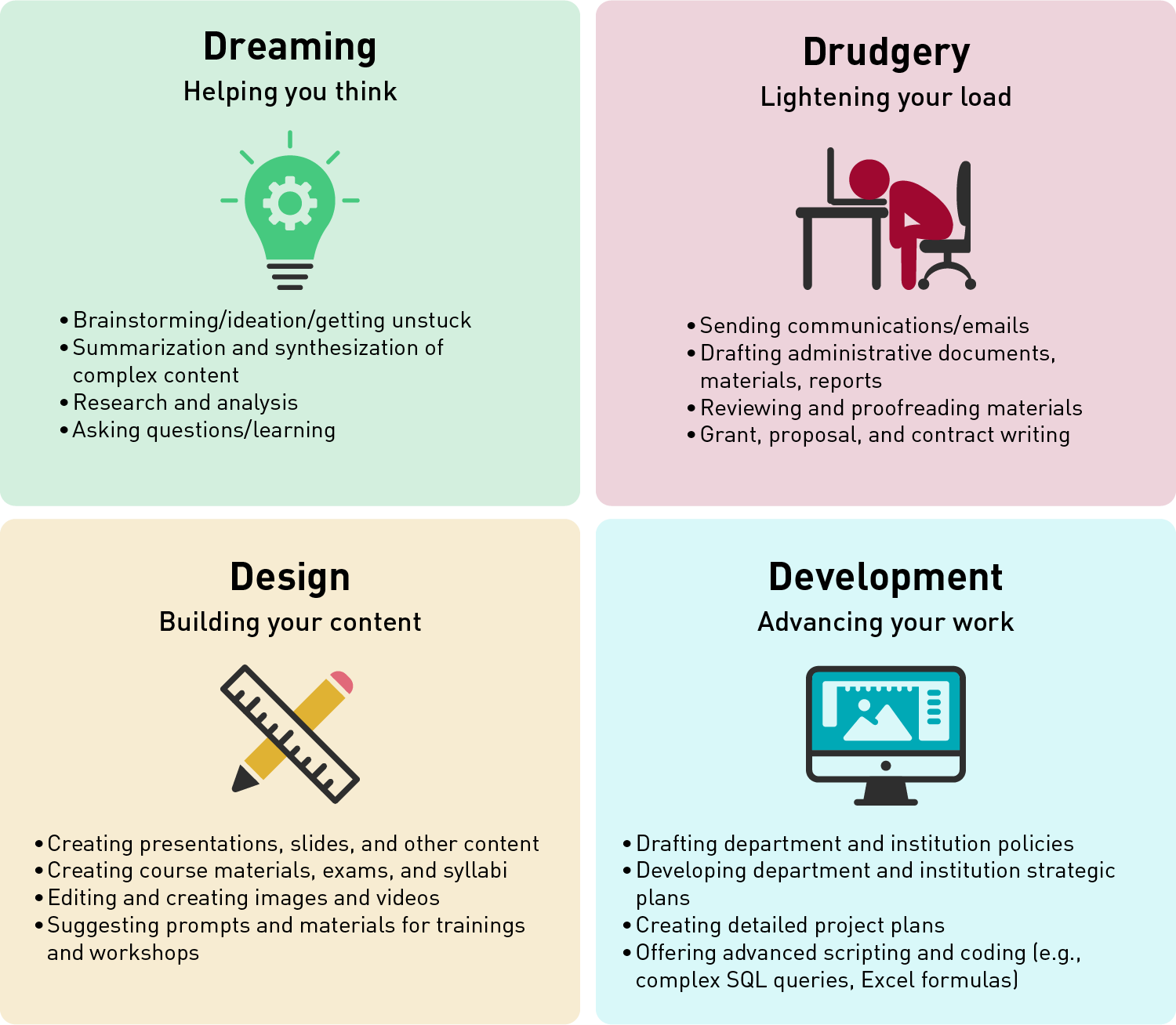

Und damit ist der/die CIO wieder im Spiel, denn es geht auch in der Administration und der Forschungsverwaltung um eine KI-basierte Assistenztechnologie. Im Workshop in Göttingen konnten wir schon einmal folgende Felder herausarbeiten, in denen sich der/die CIO in der eigenen Hochschule unbedingt einbringen muss.

1. Beratung: Zu allererst geht es um eine strategische Beratung, ein Aufzeigen von Technologieszenarien gegenüber Hochschulleitung und Fakultäten. Hier könnten Szenarien erzeugt werden, wie eine KI-unterstützte Lehre bzw. KI-unterstützte Forschung in 1,3 oder 5 Jahren aussieht. und was das für die Ausrichtung der Universität bedeutet. Wir denken, dass die konkreten Bilder eher von den Fachdisziplinen ausgemalt werden, aber es ist Aufgabe der CIOs, das Thema KI und Vergleichsfälle an diese für eine weitere Diskussion heranzutragen.

2. Erprobung: CIOs sollten sich Verbündete suchen, um Einsatzmöglichkeiten von KI in Verwaltungsanwendungen (z.B. im Dokumentenmanagement), in der Nutzerschnittstelle (Chatbots), im Forschungsinformationssystem (z.B. Clusteranalysen) oder zur Bild- und Textgenerierung für Presse und Marketing auszutesten. Ein konkretes Vorgehen könnte das Higher Education Reference Model (HERM) nutzen, um für jede Business Capability aufzuzeigen, wann KI dort zu erwarten ist und dann proaktiv nach Cases zu suchen. Allerdings sollte man hier mit Bedacht vorgehen: auch ein mit KI unterstützter, aber ansonsten schlechter Prozess wird durch KI nicht automatisch besser.

3. Erwartungsmanagement: Die Erwartungen der Anwender an KI sind derzeit noch nicht stabil -- mangels praktischer Erfahrungen im Umgang mit der Technologie reichen die Ideen von einer reinen Extrapolation des Bestehenden, über Weltuntergangsszenarien, zur Ablehnung oder Abwertung der Technologie. Um wirklich beurteilen zu können, welche Anwendungsfälle und welchen Nutzen KI haben wird, ist es notwendig, Personal zur Beratung in der Hochschule auszubilden, sowohl bei wissenschaftlichem Nachwuchs (wegen der Änderungen in der Forschung), als auch in der Verwaltung.

4. Beschaffung: es ist derzeit noch vollkommen im Fluß, wie der technische Zugang (Schnittstellen, Plugins, Cloud vs. On-Premise) zu Generativer KI aussehen wird. Noch wesentlich wichtiger ist aber der wirtschaftliche Zugang: was ist am günstigsten, wenn man einem ganzen Campus Zugang gewähren möchte: flat-rate Campuslizenzen pro Person? token-basierte Lizenzen pro Zugriff? Für welche Benutzergruppen? Sollte man mit verschiedenen KI-Anbietern parallel Verträge machen oder geht man doch über Zwischenhändler bzw. Aggregatoren? CIOs sollten sich einen Überblick über Anbieter schaffen, auch durch Vernetzung mit anderen (Digitalverbund, HFD, etc.).

Da ist doch einiges zusammengekommen. Ich würde mich freuen, über Ihre Erfahrungen an der eigenen Hochschule zu hören!

Donnerstag, 2. März 2023

Three C's and their vitamin shock for Universities

The importance of the last five years for the digitization of Universities cannot be overestimated. More has happened fundamentally in these five years than in the 30 years before, and the reason for this lies in the three "Cs": Cloud, Covid and ChatGPT. Together, these words represent 3 vitamin shocks and will massively change the way universities approach their digitization.

The first "C" is the cloud. As I've written elsewhere, the availability of Amazon Web Services, Microsoft 365 or Google for Education is a fundamental way to get rid of your own data center. However, this is at the cost of a Babylonian captivity to the cloud provider, who, exploiting the lock-in effect, can drive a pricing policy that brings universities to the edge of their own funding possibilities as the level of digitization increases. But in the best of all worlds, there is always the latest software, worldwide accessibility of the platform and a 24/7 helpdesk.

The second "C" in 2020 was the shock of the Covid19 epidemic. At breakneck speed, universities flexibilized face-to-face teaching, introduced flipped classroom concepts, and enabled distance exams. Instructors recorded thousands of instructional videos, which were so well received that even after the pandemic ended, students do not want to give up hybrid teaching and the options they had once learned about. Back to large and crowded lecture halls with solo entertainers at the chalkboard? Not with our students! Similarly, the impact on the work modes of administration and academics. Home office for administrative staff: an absolute rarity in 2019, quite common since 2021. Work meetings, even scientific conferences take place via Zoom.

The third "C" in 2023 is the worldwide availability of generative artificial intelligence (example ChatGPT), whether for the creation of texts, images, or software. In addition to the de facto death blow for the essay assignments, generative AI also enables a leap in productivity, be it through easier writing of scientific texts, simplified summarizing of sources, better translations or better graphics. When Richard Socher was asked at DLD23 about GAI's current failures (hallucinations) in properly linking sources, he succinctly said, "Give us a few more weeks" (addendum: LLaMa, GPT4).

For me, the essential commonality of all three vitamin C shocks is that they happened past the traditional university data center. The old servers are no longer needed. What we do need, however, is a university-wide digitization strategy, knowledgeable staff for local support, and a training campaign for using the new services. Are our universities properly positioned for this in terms of personnel and funding?

Translated with DeepL

Sonntag, 26. Februar 2023

Does ChatGPT level the differences between the world's best universities and everyone else?

Is there a power imbalance between American and European universities when it comes to publication impact and research funding? Of course: elite institutions like Harvard, Stanford, and Oxford lead the way, while smaller universities such as Bayreuth linger in the long tail. This holds for the attractiveness for younger researchers searching for a career, the impact factor of publications, and usually the endowment with research funding.

Will AI, available to everyone, even out the playing field? Is it a game-changer? It might be since tools like ChatGPT and other AI solutions are accessible globally. All that's needed is an internet connection and a desktop computer. It won't matter where the researcher is located--whether it's Mombasa or Miami, Bangalore or Boston, Frankfurt or San Francisco--as long as they know how to make use of generative AI and publicly available data.

The conversations about the implications of AI on universities can be looked at in two ways. Supporters of the concept posit that high-end universities have the capacity to use their wealth and receptiveness to technology to carry out AI research projects, resulting in a greater disparity in resources between these universities and those without as much financial backing.

On the other hand, one of the greatest opportunities afforded by AI is the democratization of opportunity. Through the use of open-source software and resources, anyone from anywhere can access the same tools and data sets. This evens the playing field for everyone, regardless of location or means. Furthermore, success in using AI will depend more on creativity and innovation than financial resources, allowing those with a limited budget to still make advances in their research. In this case, the chasm could decrease as anyone with access to open AI resources has the potential to succeed, regardless of their geographic location.

Attending DLD23 in Munich in January 2023, I was lucky enough to approach Erik Brynjolfsson and Andrew McAfee with this question. Their answers differ in detail, but the general sentiment is: the power curve is rock solid, and if you are a small university somewhere in the long tail, you have to act fast.

Erik's answer was: The power law between American and European universities will likely still be in effect when it comes to publication impact and research funding. Elite institutions like Harvard, Stanford, and Oxford will continue to lead the way, while smaller universities such as Bayreuth will remain in the long tail. However, AI could give a new competitive edge to universities that are quick to act on embracing the technology. Those that provide their researchers with technical access and capabilities, use AI in teaching and exams proactively, and create an AI-friendly environment that allows for experimentation with data sets have the potential to move up the power law curve faster than those who are slower at adapting. On the other hand, those who try to suppress using AI or go back to traditional methodologies risk further falling behind. Ultimately it is up to each university’s leader(s) to determine whether they want to move up or slide down this curve.

Andrew's answer: We do not know the answer to that question yet. However, most new technologies have throughout the years increased the effect of the power curve, one way or the other. What might happen if you look at a particular researcher, is that AI is a diamond seeker, meaning that AI is very much capable by sifting through tons of research writings to detect promising new research better than humans might do (e.g through a manual structured literature review, which is always biased). In that case, researchers will get increased visibility even if having few publications (early career) and then be capable to move to a better university up the power law curve. Even when you have the same access to research tools regardless of geography, it is still more attractive to the particular researcher to move where brains who you can go to lunch with, are in one place.

Disclosure: this blog post has been drafted, translated, edited and proofread using sudowrite.com and deepl.com.

Dienstag, 23. August 2022

German Universities and the cloud -- what do we need to do?

The accelerated digitization of German colleges and universities in 2020/2021, in response to the COVID19 pandemic, would not have been possible without the massive uptake of cloud offerings. Teaching via video conferencing systems such as Zoom, digital remote exams with and without proctoring, and collaborative work via collaboration systems such as Confluence or Microsoft Teams found their way into the normal working day virtually overnight. More digitization happened in a few weeks than in the years before. Cloud providers such as Zoom, Google, and Microsoft captured shares of the digitization budget to a much greater extent than ever before planned. It became very clear during this period that the pre-pandemic digital world was caught up with a reality for which the universities and their administrations, which were nevertheless quite slow to act, were not prepared in their basic structures.

Cloud services extend the IT services previously used in universities and are mostly provided by their own data centers. They can be set up quickly and decentrally on PCs and notebooks and used by university staff. They do not lead to the acquisition of new large-scale equipment in the data centers, but they do lead to demand for user support from existing IT staff.

Utilization of these additional options, which are intended to improve the attractiveness and competitiveness of a university, is only possible after fundamental, internal considerations. Whereas in the past a data center or IT department could decide for itself whether to introduce software, the use of cloud services raises strategic issues that can only be resolved at the level of university management. The relocation of parts of the IT infrastructure, including data storage "off-campus", has implications for digital sovereignty, the design of basic infrastructures, or personnel development. In addition to new opportunities, unexpected dependencies arise. Recommendations for the concrete use of cloud services in universities were published by ZKI e. V. in 2021 in a result report with specific recommendations. The HRK has taken up the topic with Circular No. 26/2021.

There are strategic questions that must be fundamentally answered at the level of university managements, CIOs, ministries, federal states HRK before cloud use. They concern organizational, legal, and financial framework conditions.

Digital sovereignty: Most German universities operate their own data center. There are many reasons for this. Cloud services have been added during the pandemic. With cloud services, there is perceived uncertainty about the long-term development of license fees, as well as a dependency due to the increasing integration of cloud services into everyday operations (vendor lock-in). In the future, universities will have to weigh up on a political level whether such uncertainties and dependencies should be accepted or whether providing services in their own data center is fundamentally a sovereign path.

Cooperation structures: Private clouds could represent a middle ground between a company's own data center and cloud services from commercial providers. These could be either inter-university offerings via state data centers or the direct provision of services between universities. The decision on cooperation will have to be made partly by the universities themselves and partly in dialog with the state ministries. This also raises the question of the institutional structure of the cooperation. The state of Bavaria is attempting to establish this cooperation as a statutory task by founding a digital alliance (cf. Art 6(5) of the Higher Education Innovation Act) and to address the issues jointly across all types of higher education institutions.

Fiscal aspects of cooperation: the purchase of IT services is subject to VAT unless it is scientific cooperation. This applies to commercial cloud offerings (Microsoft 365, Zoom), but also, depending on the design, to inter-university offerings via the above-mentioned cooperation structures. Unless there is a provision in tax law here, e.g. that cooperation between universities is a public task, an IT service via cooperation may be up to 19% more expensive than providing the same service via an own university computer center.

Procurement: the current ways of procuring IT services are geared toward operating their own university computer centers. In the nationwide DFG funding program "Grossgeräte der Länder", they are half-subsidized with federal funds. Therefore, state-funded universities have no incentive to consider cloud services as a substitute if they have to pay for them in full.

Support structures: academics are used to being able to request assistance from commercial data centers, networks, and cloud operators 24 hours a day, 7 days a week. Small to mid-sized universities cannot provide this support. What does this mean for future workforce planning?

Sustainability: Increasingly, the university's own IT provision needs to be climate-proofed. For the state of Bavaria, an initial study has revealed a need for construction measures in the double-digit millions to meet the climate targets set by the state and federal governments concerning existing university data centers. Should these investments still be made when "everything is going to the cloud"?

The search for legal frameworks regarding the necessary cloud use in a European, or better, the inner-German legal framework is obvious. The Zoom provision of the DFN via the Telekom cloud shows an inner-German way for personal data of students and researchers, the NFDI for research data. However, cloud-based delivery of online university elections is not yet possible in many countries and is the subject of ongoing legal discussions.

With these issues in mind, it is necessary to take a hybrid view of the reliable and sustainable provision of IT services and to create prerequisites in each direction. The goal must be to efficiently operate IT infrastructures for universities that have been built and maintained with tax funds.


Translated with DeepL, edited with Grammarly.

Montag, 27. Dezember 2021

Leave the digital transformation of teaching behind you!

 As I wrote in an earlier post, shortening "digital transformation of the university" to "digital transformation of teaching" seems to me to fall short. And for that, you don't have to resort to the Humboldtian ideal, but simply look at what members of a university spend most of their time doing -- at many universities, it's research.

Sure, professors go into the lecture hall at least once a day (in pre-Corona times), staff members prepare slides and supervise seminar papers, and the secretary's office sells lecture notes and accepts applications for recognition of exchange. These activities do not change, from semester to semester, from day to day a similar procedure. Hundreds of such operations in a month in a department, thousands in a faculty, hundreds of thousands in a university. So you might get the idea that these (repetitive) activities are the reason the university exists -- and you couldn't be more wrong.

Because researchers are actually driven by the search for the creative, the innovative, the insight. The next discovery, the lab result, the scientific discussion, the publication is the means to get ahead.

If we see digital transformation only as a means of doing what we do more efficiently: if we supplement our own face-to-face lectures with digital videos, store research data in a national cloud instead of on our University servers, offer MBA courses globally in English -- where is the strategy there? It's a digital extension of the same, a step into an international arena whose rules of the game we need to understand before we can make sense of it.

Digital transformation is changing a lot of things -- including university strategy. Universities with excellent, high-profile basic research can monetize education and training in these areas. Universities with impressive campuses create a sense of belonging that inspires alumni decades later. Much research and teaching content transports itself over the Internet -- depending on whether a university transports itself as a sender or receiver of this content, its own strategy must adapt.

You can spend a lot of money on digital transformation of universities; but it should be spent strategically in the right place. I doubt that this money is well spent on digital teaching.

Translated with DeepL